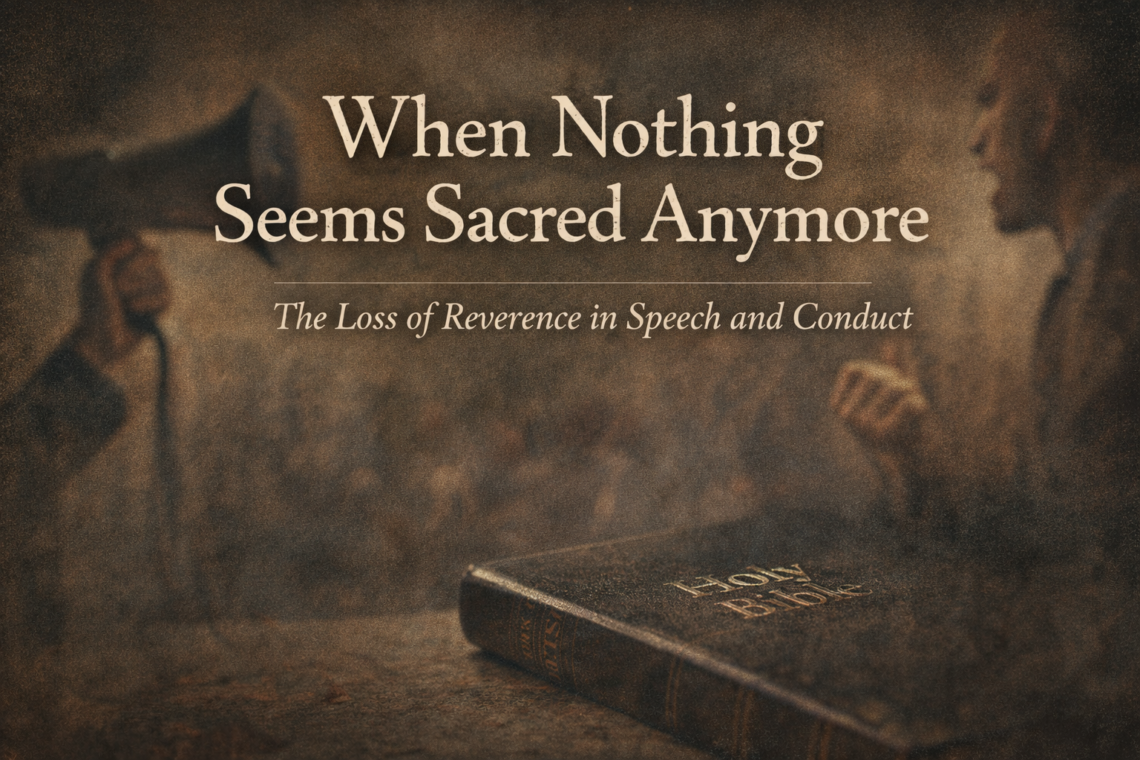
“Once a man lived so long in a noisy room that he forgot silence could even exist. When he was finally led into a holy place, he kept talking as if nothing had changed.”
That is what modern life can do to us. If we are honest, many of us have watched the tone of the world change right in front of us. People speak faster, harsher, and with far less restraint than they once did. Things that should make us pause are now brushed off with a joke. Words that should carry weight are treated like filler. Conduct that would once have been called shameful is now celebrated as bold or authentic. I do not think this is a small matter. I believe it points to something deeper: we are living in an age that is losing its sense of reverence.
When I say reverence, I do not mean artificial stiffness or a forced religious tone. I do not mean walking around sounding gloomy or trying to impress people with solemnity. Reverence is something deeper than style. It is the recognition that some things are sacred, some words matter, some moments require restraint, and God Himself is not to be treated casually. Reverence affects how we speak, how we behave, how we worship, and how we treat other people.
That is why Scripture speaks so seriously about the tongue. Jesus said in Matthew 12:36 that men will give an account for every careless word they speak. That verse should slow all of us down. We live in a world that treats speech as cheap, but the Lord does not. Words are not weightless. They reveal the condition of the heart. When speech becomes crude, reckless, mocking, and flippant, it often signals that the soul has lost its feel for what is holy.
You can see this all around us. In ordinary public life, people say things now that would once have brought immediate shame. Profanity is common. Mockery is constant. Outrage is treated like entertainment. Even serious matters are filtered through sarcasm and spectacle. Public life reflects it. Social media multiplies it. Everyday conversation absorbs it. What troubles me is not only that the language has become uglier. It is that many people no longer seem to believe anything is worth handling with care.
That same spirit can creep into behavior. When reverence fades, self-control usually goes with it. People interrupt more, lash out faster, laugh at things they should grieve, and treat others with less dignity. Courtesy begins to look weak. Restraint begins to look fake. Humility begins to look unnecessary. But Scripture teaches the opposite. Ephesians 4:29 tells us to use words that are good for edification. That means our speech should help, not merely express. It should build, not just vent. It should be governed, not impulsive.
I think one of the saddest parts of this decline is what it does to our ability to worship. A person who spends all week speaking carelessly and living casually should not assume reverence will suddenly appear when the church assembles. A heart trained to treat everything lightly will struggle to tremble before God. Yet that trembling is exactly what Scripture commends. Isaiah 66:2 says God looks with favor on the one who is humble, contrite, and who trembles at His word. That kind of spirit does not happen by accident. It must be cultivated.
And I think that is where the challenge becomes personal. It is easy to blame culture. It is easy to point at politics, media, or younger generations. But the real question is whether I am reverent. Do I govern my tongue? Do I speak of God carefully? Do I treat worship seriously? Do I show dignity toward others because they bear the image of God? Do I know the difference between joy and irreverence, between boldness and coarseness, between honesty and recklessness?
The answer is not fake seriousness. Christians are not called to be cold or theatrical. But we are called to be sober-minded, self-controlled, and aware that we live before the face of God. In an age that rewards shock, noise, and carelessness, reverence is a powerful witness. It shows that the heart still feels the weight of truth. It shows that God is not common to us. And frankly, I believe we need more of that—not less.