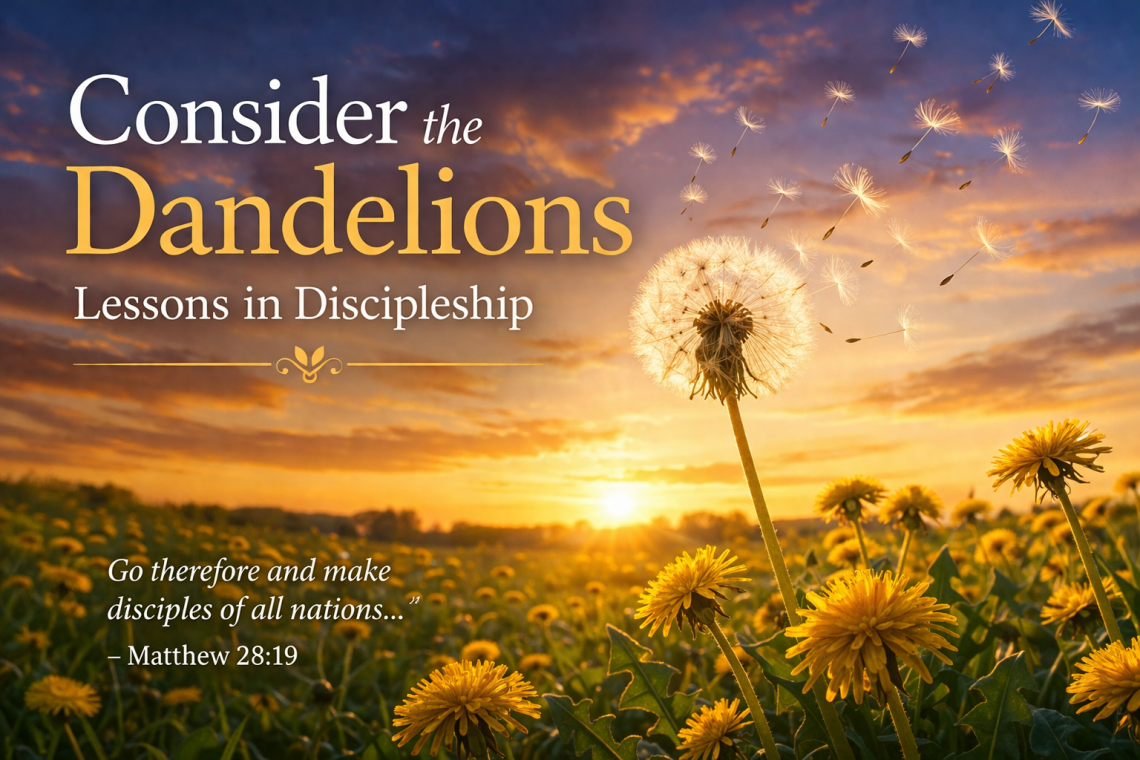
For the past several weeks I have been part of a Bible study focused on discipleship. Although I’ve been a Christian for many years and have long understood that discipleship is not merely encouraged but commanded, I realized recently that I had never truly learned what intentional, biblical discipling looks like in practice.
One evening, on my way to the study, a simple sight captured my attention: a yard full of dandelions. Most of us tend to see dandelions as a nuisance, an invasion of stubborn yellow flowers in an otherwise well-kept lawn. When we spot a single puffball crowned with countless parachute seeds, we groan, knowing that once the wind catches them, dozens more will appear. Many people do not even consider dandelions flowers at all, but weeds, something to be removed quickly and discarded without a second thought. Yet dandelions are far more remarkable than we assume. They hold surprising nutritional and medicinal value. Their leaves and roots are edible. They contain vitamins A, C, and E, along with iron and potassium. They aid digestion and support liver health. They are hardy plants too. Their roots can reach astonishing depths, sometimes up to fifteen feet. If even a small piece of the root remains in the soil, the plant can regenerate.
And it was there, staring at a field of what most people would dismiss, that the Holy Spirit reminded me of something profound. What do dandelions have to do with discipleship?
Well, Quite a lot.
In Matthew 28:18–20 Jesus gives His disciples the Great Commission, the final recorded command He leaves before His ascension. Jesus tells them, “Go therefore and make disciples of all nations, teaching them to observe all that I have commanded you”. These are not optional words. They are Christ’s final earthly instruction before He was taken up into heaven and sat down at the right hand of God as Mark 16:19 describes. Final words matter. Consider how important that message must be to Jesus if they were the final thoughts and words He shared. These words carry eternal weight.
So, what does this have to do with dandelions?

Consider this. A single dandelion can produce thousands of seeds. Some sources estimate up to 20,000. Each one has the potential to create new life. And dandelions are not selective about where these seeds land. They scatter everywhere, into pristine lawns, cracks in the sidewalk, empty fields, and unexpected places. This, Jesus says, is what disciple-making should look like. His gospel is not meant to remain contained or selective. Christ came for all people. Scripture confirms this again and again. Ephesians 2:14 tells us that “He has broken down the dividing wall”. Ephesians 3:6 reminds us that, “the Gentiles are fellow heirs”. Revelation 7:9 reveals that “before God’s throne will stand people from every tribe and tongue and people and nation”.
The gospel is a message meant to spread across cultures, across boundaries, and across generations.
Like dandelions, disciples of Jesus are meant to multiply.
Now here is what I learned in the discipleship class about discipleship. As we go and make disciples, we must remember that the Great Commission is not fulfilled merely by sharing the message once or scattering seeds without care. We must build relationships with people. We must invest in them so that they grow to love being in our presence, desire to learn more, and long to be part of God’s family. If we neglect the relational aspect of discipleship, many will hear the word but quickly fall away, just as Jesus warned in the parable of the sower. We must take time to know people, to walk with them, and to cultivate an intimacy rooted in care and consistency, just as God intimately knows each one of us. Jesus Himself modeled this. He did not merely teach the gospel to the twelve and send them away. He lived with them, traveled with them, ate with them, prayed with them, and built deep bonds of trust and affection. In doing so, He showed us what relational discipleship truly looks like.
Finally, there is yet another lesson in the dandelion’s design. Its roots.
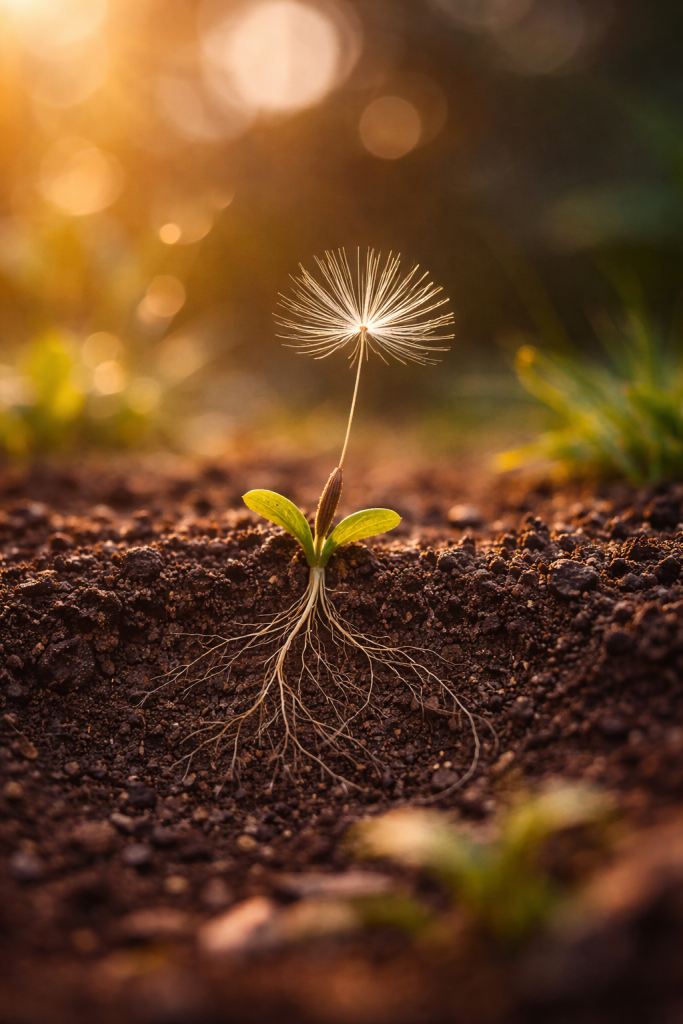
A dandelion can regenerate because its roots grow deep. Likewise, believers who continue to “grow in the grace and knowledge of our Lord and Savior Jesus Christ”, as 2 Peter 3:18 teaches, develop deep spiritual roots. These roots anchor them in trials, nourish them in truth, and strengthen them to bear fruit that lasts as Jesus describes in John 15. Deep roots make resilient disciples. And resilient disciples can help produce more disciples. So, consider the dandelion, not as a weed, but as a teacher.
Let its persistence remind us of the gospel’s unstoppable nature.
Let its abundance call us to bountifully share God’s message
Let its deep roots invite us to grow in maturity.
Let its scattering seeds inspire us to go wherever God sends.
Christ has entrusted us with His message. He has commanded us to make disciples.
He has promised to be with us always, to the end of the age.
So go, into every place God leads. Scatter seeds of truth. Share the beauty of Christ with everyone you meet. Invest in meaningful relationships as Jesus did. And trust that God will grow His family through faithful, intentional obedience.
Let us be like the dandelions, small, persistent, unexpectedly fruitful, joyfully participating in the work of God’s kingdom.