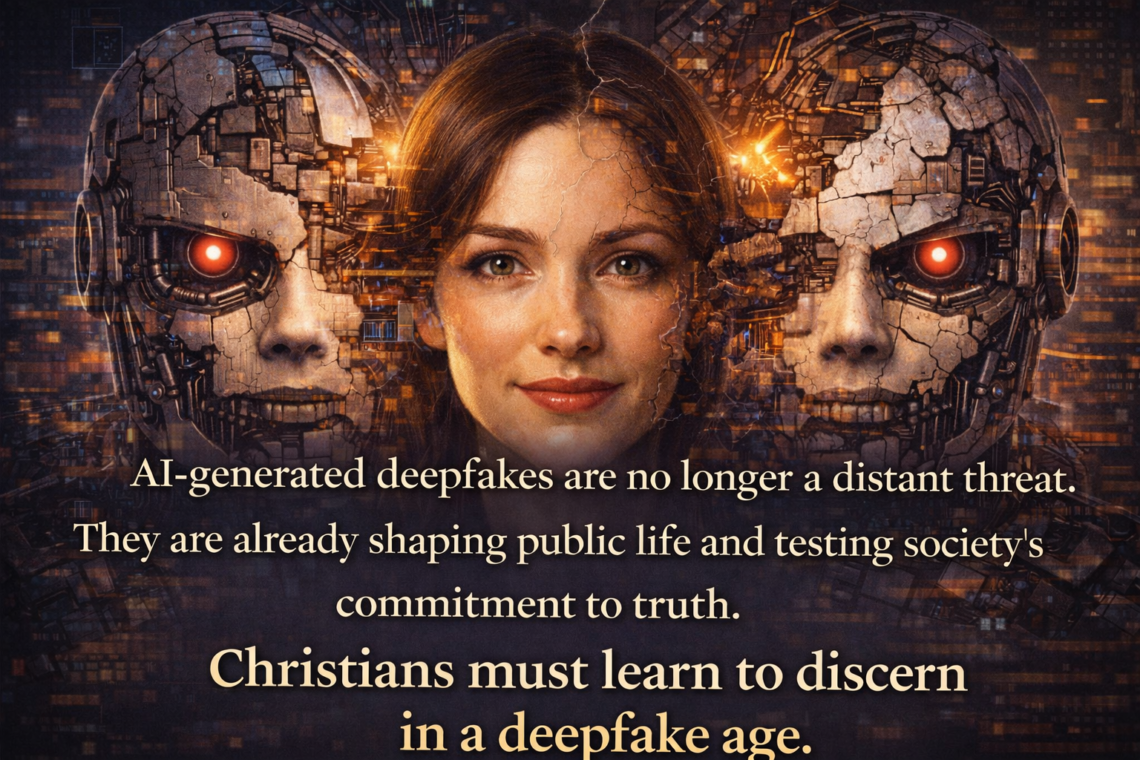
A Reuters report published on March 28 described how AI-generated deepfake videos are already being used in the 2026 U.S. midterm campaigns. The report noted that some of these videos make candidates appear to say things they never actually said, sometimes with only small, easy-to-miss disclosures. Reuters also reported that there is no federal law broadly regulating AI in political messaging, leaving a patchwork of state rules while experts warn that this technology could further erode public trust.
That is not just a political problem. It is a moral problem.
Scripture has always treated truth as sacred. God does not merely forbid lies because they create inconvenience. He forbids lies because they corrupt judgment, damage neighbor-love, and distort reality itself. “Therefore, laying aside falsehood, speak truth each one of you with his neighbor” (Ephesians 4:25, NASB). When a society becomes comfortable with manufactured deception, it does not simply lose accuracy. It loses moral stability.
That is why this issue matters to Christians. Deepfakes are not just clever media tools. In many cases, they are instruments designed to persuade by impersonation. Reuters reported that political strategists and researchers say such videos are persuasive, inexpensive, and increasingly easy to make, while studies suggest many people struggle to identify them correctly. That means falsehood is becoming faster, cheaper, and more believable.
And that should trouble every Christian.
The devil has always trafficked in distortion. Jesus said of Satan, “Whenever he speaks a lie, he speaks from his own nature, for he is a liar and the father of lies” (John 8:44, NASB). The technology is new, but the sin is old. Evil has always loved disguise. What changes in our time is scale. A lie that once spread by whisper can now spread by algorithm, video, and artificial voice in a matter of minutes.
Christians must not respond to this merely as partisans. We must respond as people of truth. That means we should be slower to react, slower to share, and slower to believe sensational content simply because it confirms our suspicions. Proverbs 18:17 reminds us that the first side of a matter can sound convincing until another examination is made. In a deepfake age, that proverb becomes even more practical.
This also means we need to teach our families that seeing is no longer the same thing as knowing. Previous generations warned, “Do not believe everything you hear.” Our generation must add, “Do not believe everything you see.” Discernment is no longer optional. It is part of faithful living.
There is another danger here. If people come to believe that everything can be faked, they may stop trusting legitimate evidence as well. Reuters quoted a researcher warning that the technology risks damaging the rigor and credibility of elections and democratic systems. Once trust collapses, cynicism rushes in. And cynicism is fertile ground for manipulation.
Christians should be different. We should be known as people who love truth, test claims carefully, refuse dishonest shortcuts, and do not delight in falsehood even when it appears useful to our side. Truth is not a tactic for the disciple of Christ. It is a duty.
The world may learn to manufacture convincing illusions. The church must become even more committed to reality, integrity, and truth. In an age of artificial speech, God’s people must speak honestly, judge carefully, and refuse to help lies travel.