“LADIES AND GENTLEMEN… tonight’s main event is scheduled for ONE FALL—AND IT WILL LAST UNTIL DAYBREAK!”
In this corner, you’ve got Jacob—nervous, calculating, carrying a lifetime of baggage. And in the other corner, you’ve got… God. Not a rival. Not an equal. Not an opponent you can outmuscle. Which is exactly why this moment qualifies as one of the most jaw-dropping “firsts” in Genesis: this is the first time in Scripture a man wrestles with God and lives to tell the story (Genesis 32:24–30).
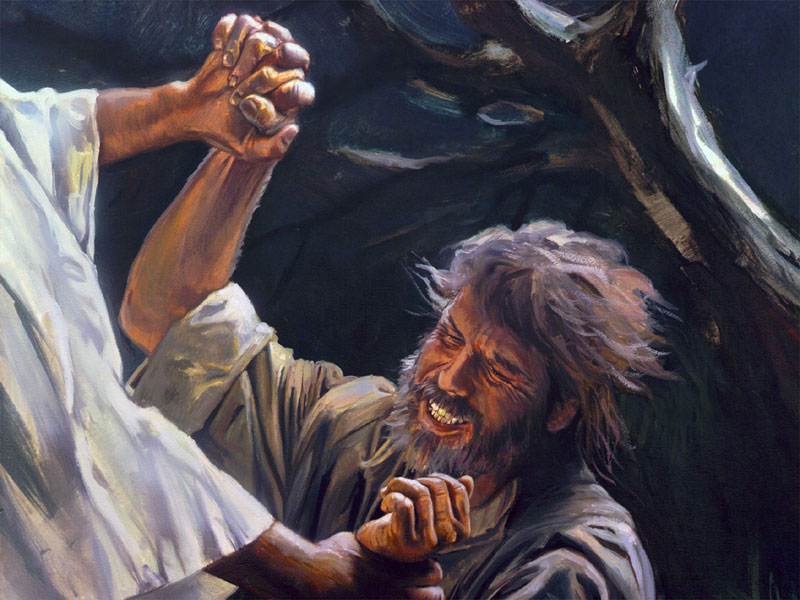
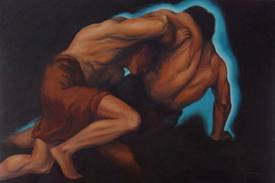
I know how that sounds. “Wrestled with God” can feel like a poetic way of saying “he struggled spiritually.” But Genesis won’t let me soften it. Jacob is alone in the dark, and “a man” shows up and they start grappling—real contact, real strain, real resistance. The verb used there carries the sense of “grappling in close, dusty struggle.” This isn’t a distant vision. It’s personal, physical, and intense—like Heaven stepped into Jacob’s space and said, “We’re dealing with this tonight.”
Now, I want to be fair to the text and clear for the reader: Genesis 32:24 introduces the wrestler as “a man.” That’s the immediate description. But the passage itself does not leave it there. As the scene unfolds, the language climbs.
When the night ends, the “man” renames Jacob and explains what just happened: “You have striven with God” (Genesis 32:28). Then Jacob names the place and says, in plain terms, “I have seen God face to face, yet my life has been preserved” (Genesis 32:30). In other words, Jacob’s own conclusion is that this encounter was with God. In the Hebrew text, the word Jacob uses there for God is Elohim—not a vague term like “a higher power,” but the common biblical word for God. So while the narrative begins with “a man,” Jacob interprets the event as a divine encounter with God Himself.
That also helps make sense of something readers notice when they compare passages: Hosea later reflects on this same incident and says Jacob “wrestled with the angel” (Hosea 12:4). That isn’t a contradiction so much as a layered description: Genesis describes the figure as a man, Jacob says it was God, and Hosea emphasizes the messenger/angel aspect. Whatever category someone chooses—angelic messenger, divine representative, or a special appearance of God—the text is crystal clear on one point: Jacob walked away convinced he had encountered God and survived by mercy.
To feel the weight of the moment, I’ve got to remember what led up to it. Jacob is on his way back home after years away, and the one person he never really made peace with—Esau—is coming to meet him with four hundred men (Genesis 32:6). That is not “family reunion” energy. That’s “I might not make it out of this” energy.
So Jacob does what Jacob has always done: he plans. He divides his camp, tries to control the odds, and sends gifts in waves to soften Esau (Genesis 32:7–21). But something else happens too—he prays. And it’s not a polished, churchy prayer. It’s a desperate one. He reminds God, “You told me to come back,” admits he doesn’t deserve the kindness he’s already received, and begs God to deliver him (Genesis 32:9–12). In other words, Jacob is terrified, but he’s finally starting to put his fear in the right direction.
Then he sends his family and everything he owns across the river, and Genesis drops this quiet line: “Jacob was left alone” (Genesis 32:24). That sentence is the doorway into the fight. Because God has a way of doing His deepest work when there’s no audience and no noise. Jacob can’t manage his image in the dark. He can’t distract himself. He can’t control the situation with another clever move. He is alone with what he’s always been… and what he’s afraid he still is.
That’s when the “man” shows up and wrestles him until daybreak (Genesis 32:24). And I have to say it clearly: this is not Jacob picking a fight with God. This is God coming to Jacob. God initiates. God closes the distance. God forces the issue.
And then the story does something brilliant. It lets Jacob fight hard, but it also makes sure I don’t miss who’s really in control. At some point, the “man” touches Jacob’s hip and dislocates it (Genesis 32:25). Not a punch. Not a struggle. A touch. That one detail tells me the whole match has been restrained power. God hasn’t been trying His hardest—He’s been working Jacob over, not because He hates him, but because He intends to change him.
As dawn approaches, the “man” says, “Let Me go, for the dawn is breaking” (Genesis 32:26). And Jacob—now injured, now limping, now running out of options—says the line that shows his heart has shifted: “I will not let You go unless You bless me.” That is not swagger. That’s not winning. That’s a man who has finally realized, “If I’m going to make it, it won’t be because I outplayed everybody. It’ll be because God has mercy on me.”
Then comes the question that cuts deeper than the hip injury: “What is your name?” (Genesis 32:27). God isn’t asking for information. He’s pulling something out of Jacob. Because saying your name in that moment is basically saying, “Here’s who I’ve been. Here’s the pattern. Here’s the truth.” Jacob answers, “Jacob.” No speeches. No excuses. Just the truth.
And that’s where the “first” turns from a fight into a rebirth. God gives Jacob a new name (Genesis 32:28). That’s huge. Jacob asked for a blessing, but what he gets is deeper than a gift—he gets a new identity. It’s as if God is saying, “You’re not walking into tomorrow as the same man who walked into tonight.”
Jacob then asks for the other fighter’s name, and he doesn’t get it the way he wants (Genesis 32:29). The blessing comes, but God doesn’t let Jacob treat Him like a label you can capture and carry around. That matters for me too. I don’t get to reduce God to something manageable. He’s not a formula. He’s not a spiritual vending machine. He’s God.
Then Jacob names the place and basically says, “I saw God face to face… and somehow I lived” (Genesis 32:30). That line is the headline of the entire scene. This is the first time we see a man in Scripture have an encounter like this—so close, so intense, so dangerous-feeling—that he expects not to survive it. And yet he does.
And he leaves limping (Genesis 32:31). That part always sticks with me. Jacob doesn’t walk away with a victory lap. He walks away changed. The blessing came with a limp. Not as punishment, but as a reminder: “You’re not going to live the old way anymore.” Some of God’s best work in me comes with a kind of holy weakening—something that keeps me from trusting myself like I used to.
So what do I do with this as a Christian?
First, I take seriously that God may meet me in the dark—in seasons when I’m out of options, afraid, exposed, and alone. That’s not God abandoning me. Sometimes that’s God getting close enough to actually reshape me.
Second, I realize that God’s blessings often start with honesty. “What is your name?” is God’s way of saying, “Stop performing. Stop managing. Tell Me the truth about who you are.” A real relationship with God can’t be built on image control.
Third—and this might be the most important—I stop assuming the goal is to ‘win’ with God. Wrestling God is a no-win scenario if what I mean is overpowering Him. But it becomes a life-changing “win” if what I mean is clinging to Him until He changes me.
Jacob didn’t defeat God. God defeated the old Jacob—without crushing Jacob himself.
That’s why this Genesis first matters. It’s the first time a man wrestles God and lives to tell the story, and the big takeaway isn’t that Jacob was tough. It’s that God was merciful, personal, and committed to transforming him. Jacob went into the night trying to survive his past. He came out of the night carrying a new name, a new future, and a limp that proved he had been touched by God—and he was never the same afterward.