If last week showed how crumbs become surplus and closed ears become open, Mark 8:11–21 shows how full baskets can sit beside empty understanding. The scene is deceptively ordinary: a boat ride, a forgotten lunch, and a warning about yeast. But Mark uses this moment to diagnose spiritual dullness and to teach the disciples (and us) how to move from anxiety to insight.
The setup begins on shore with a confrontation. The Pharisees demand a “sign from heaven” (8:11). Jesus “sighs deeply in His spirit” (Greek: anastenaxas) and refuses. It isn’t that He lacks signs—He has just fed thousands twice. It’s that a heart fixed on control won’t be convinced by spectacle. Then Jesus and the disciples push off in the boat, and a small detail becomes the hook of the passage: “They had only one loaf with them” (8:14).
That line is more than logistics; it is irony. The disciples are surrounded by recent memories of abundance—twelve baskets after the five thousand, seven large hampers after the four thousand (8:19–20)—yet they fixate on what they lack. Into this worry Jesus speaks a layered warning: “Watch out, beware of the leaven of the Pharisees and the leaven of Herod” (8:15).
Two imperatives pile up—horaōte (“see!”) and blepete (“look!”)—like flashing lights. Leaven (yeast) is a tiny agent that works quietly, invisibly, and pervasively. In Mark, the “leaven of the Pharisees” is hard-hearted religiosity that always asks for one more proof before trusting God; the “leaven of Herod” is political calculation that treats truth as expendable when power is at stake (see 6:14–29). Different costumes, same fermentation: unbelief.
The disciples, however, mishear the metaphor. “They began discussing with one another the fact that they had no bread” (8:16). Jesus responds with a rapid-fire:
“Why are you discussing the fact that you have no bread?
Do you not yet perceive or understand?
Are your hearts hardened?
Having eyes do you not see, and having ears do you not hear? …
Do you not remember?
When I broke the five loaves for the five thousand, how many baskets (kophinoi) full of broken pieces did you take up? … And the seven for the four thousand, how many baskets (spyrides) full of broken pieces did you take up? … Do you not yet understand?” (8:17–21).
Notice how Jesus teaches. He does not add information; He calls for interpretation. He doesn’t multiply bread again; He multiplies memory. He forces the disciples to say the numbers out loud—twelve and seven—not to wow them with arithmetic but to awaken them to a pattern: in the hands of Jesus, scarcity is not the issue. Perception is.
Two details deserve a closer, scholarly look.
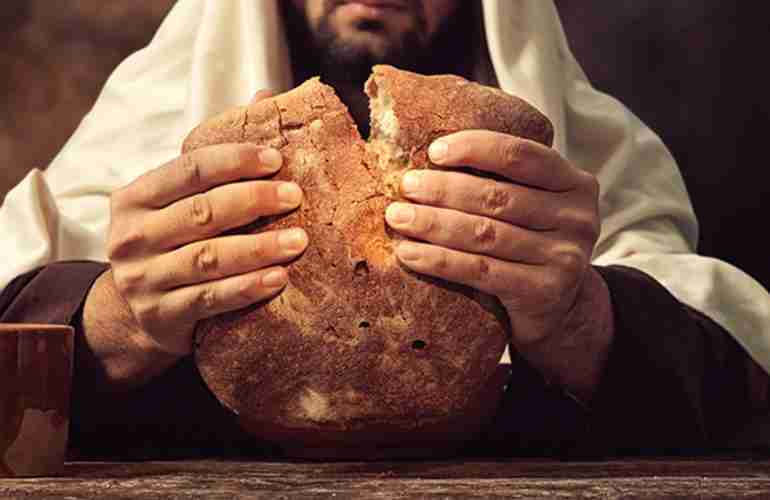
First, the “one loaf” (8:14). Mark loves suggestive details. Given what follows—Jesus Himself interrogating their vision—it is hard to miss the symbolism: they have “one loaf” in the boat because the true Bread is with them (cf. 6:41; 8:6). The problem is not a missing lunch; it’s a missing lens. Anxiety about provisions blinds them to the Presence who provides.
Placed between the feeding of the four thousand (8:1–10) and the two-stage healing at Bethsaida (8:22–26), this boat scene functions as a hinge. The disciples have seen plenty, but their grasp is still blurry. The next story—where sight moves from “men like trees walking” to clarity—will act out what Jesus is pressing for here. Understanding comes in stages, but it must come.
Second, the two words for “baskets” (8:19–20) are not incidental. After the feeding of the five thousand, leftovers fill kophinoi, the smaller, typical Jewish hand-baskets; after the four thousand, they fill spyrides, larger hampers common in the Gentile world. Jesus makes the disciples recite both terms. Why? Because their “remembering” must keep pace with the widening scope of His mission: He is sufficient for Israel, and He is sufficient for the nations. Forget either, and you will think too small—or fear too much.
What does this mean for us?
First, beware subtle unbelief. Leaven does not kick down the door; it seeps in. In church life, “Pharisee yeast” can look like permanent skepticism—perennially asking for one more sign, one more guarantee, one more condition before we trust what God has already shown. “Herod yeast” can look like baptized pragmatism—quietly sidelining truth whenever it threatens the outcome we prefer. Both ferment the same outcome: a heart that has seen baskets of grace but lives as if there is only one crust left.
Second, practice gospel remembrance. Jesus’ nine questions push the disciples to remember concretely—dates, numbers, places, who was there, what happened. Christian memory is not nostalgia; it is theology in the past tense. Rehearsed rightly, it trains the heart to expect God’s character to remain God’s character under new circumstances. If He supplied in the wilderness then, He is not less Himself now.
Third, shift from inventory to Presence. The disciples’ discussion centers on what they lack. Jesus centers their attention on who is in the boat. That re-centering is the difference between panic and peace, between misreading metaphors and hearing warnings. In practical terms, this means we ask different first questions when the church faces a deficit, a deadline, or a daunting decision: not “Do we have enough?” but “Is Jesus’ way leading us, and are we remembering what He’s already done?”
Read Mark 8:11–21 with this in mind. Hear the sigh over sign-seeking, feel the gentle urgency in the double imperative—“see” and “look”—and let the nine questions do their work. Then take inventory of your own yeast: Where has skepticism become your default? Where has expediency nicked the edge of obedience? Lay those places beside the two feedings and the “one loaf” in the boat.
You may still have only a little in hand. But you do not have a little Lord. In His presence, the question is no longer whether you have enough bread. It is whether you have learned to see.
Finally, receive the warning as a gift. Jesus doesn’t embarrass the disciples to push them away; He questions them to pull them through. The last line—“Do you not yet understand?”—is not a slammed door; it is an opened one, inviting them to step into the clarity that the next paragraph will picture with healed sight. Mark is not shaming slow learners; he is shepherding them.